Is this a sculpture or a real person?
At The Armory Show, among hundreds of works competing for attention, this was the work that made me stop and wonder.
A man sitting still on a pedestal in a yoga posture, wearing a rather ethnic-looking piece of clothing and a headpiece with a red balloon attached to it, floating high above his head.
No movement. No visible reaction. Nothing that immediately confirmed there was a living person inside that body.
Honestly, I could not tell whether I was looking at a human being or a sculpture. It intrigued me enough to start a conversation with the gallerist at Leila Heller Gallery, which was presenting the work.
He confirmed that was a real human being, the artist himself, sitting there. Darvish Fakhr was sitting on that pedestal in a meditative state and, as I was told, could hear us.
While we were looking at him, wondering about him, talking about him, he was observing, listening, thinking. So what looked, from the outside, like nothing was happening was just the opposite.
Fakhr calls this body of work States of Suspension.
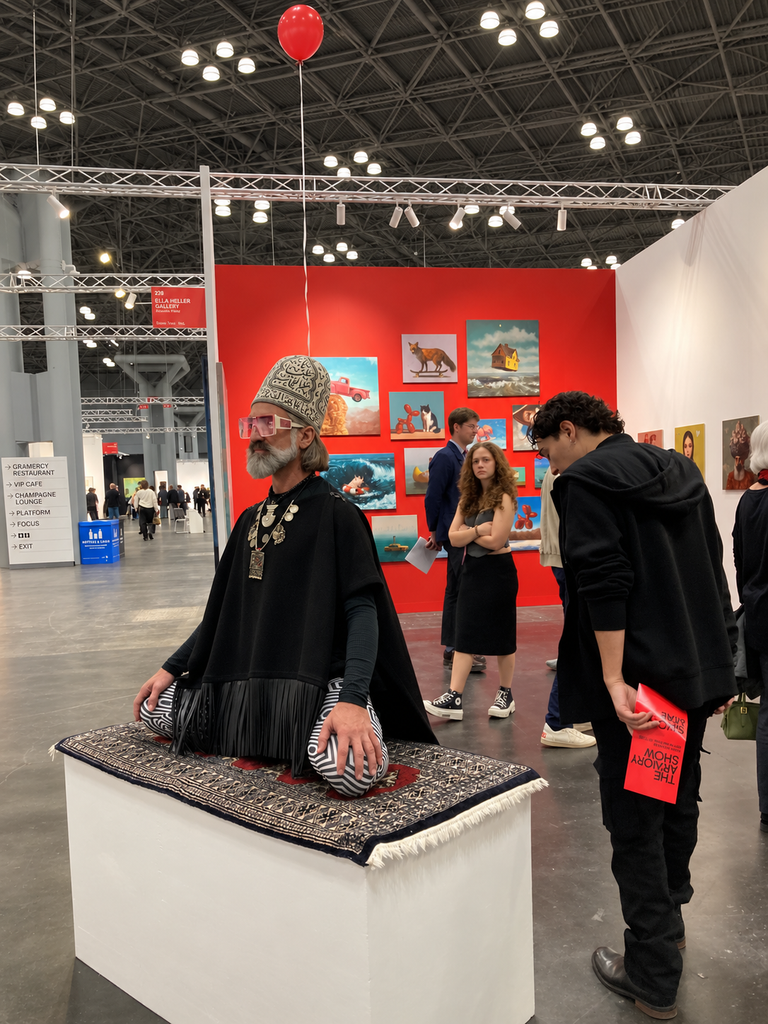
Darvish Fakhr’s work, States of Suspension.
A holistic view of his presentation at the Leila Heller Gallery booth: his paintings in the background, his performative piece in the foreground.
Notice the viewer in disbelief, circling around him, looking at his eyes, hands, hair, neck… wondering.
The gallerist explained that Fakhr uses these suspended periods as a space in which new ideas for his work can emerge.
Born in Canada to an Iranian father and a British mother, and raised in the United States, he now lives in England.
Fakhr seems to inhabit several worlds at once. And so does his work, moving between Western figurative painting and Persian cultural references, between contemporary performance and Sufi traditions, between painting, movement, and meditation.
His identity resists the comfort of one clean category. Is he Canadian, American, British, or Iranian? Is he a painter or a performer?
His work asks the same questions. Is this a real person or a sculpture? Is it movement or stillness? Is it action or non-action?
We seem to have a need for a clear answer. Ambiguity makes us restless. Yet Fakhr sat there in front of my eyes, refusing to resolve himself into either a real human being or a very well-made, realistic statue. Refusing to give me a twitch. A breath. An eyelid. Some tiny sign that would settle the question.
And in that refusal, he pushed me into action. Looking harder. Staying longer. Asking questions. Wanting to know more.
Hundreds of artworks surrounded me. Color. Scale. Technology. Materials. Spectacle.
And the work that had me stopping and thinking the most was a man acting in full stillness.
And while he remained suspended, so did I for a while.